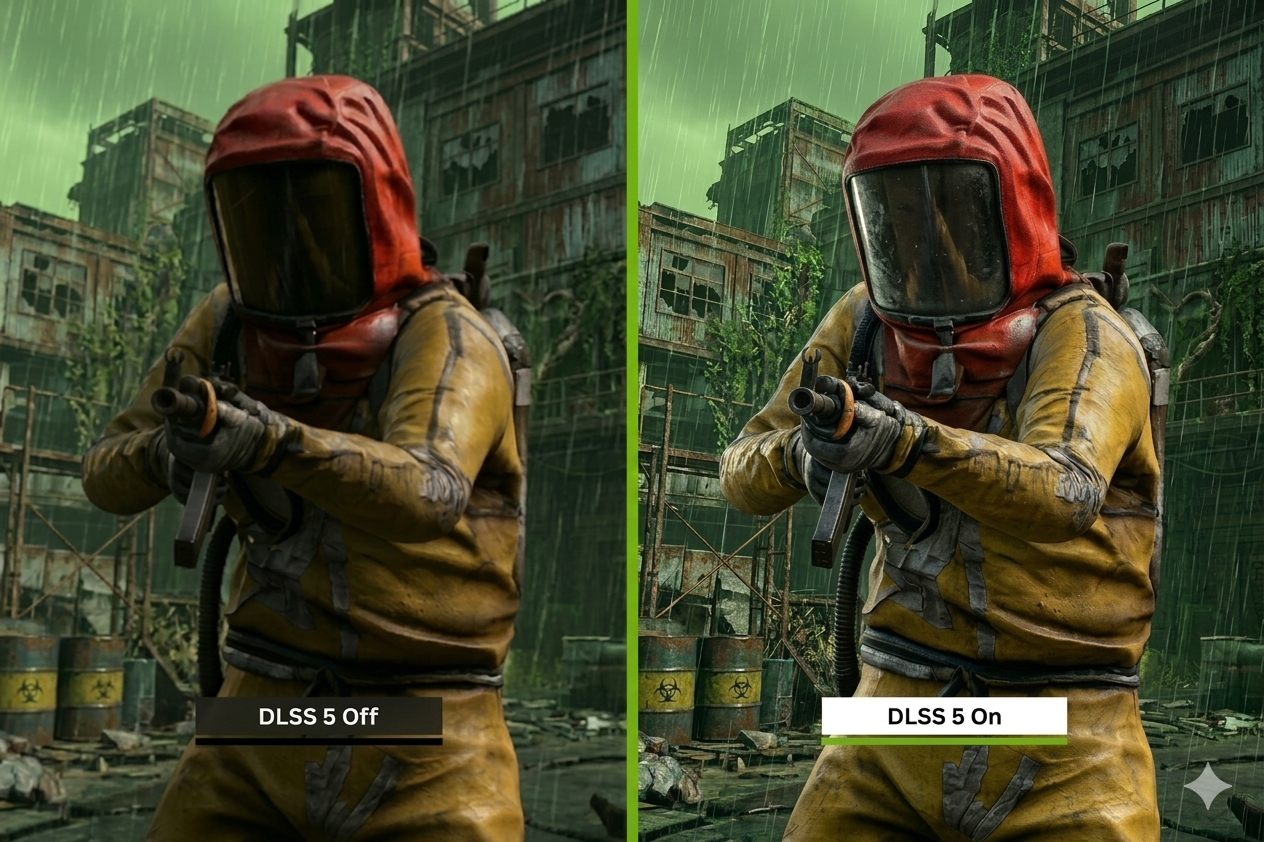
Will Rust Get DLSS 5? Everything We Know So Far
DLSS 5 just dropped at NVIDIA GTC 2026 and the gaming world is having a collective meltdown about it. Rust players are asking the obvious question: will Rust get DLSS 5 support? If you opened a new tab to check within five minutes of watching the announcement, you are not alone. Here is everything we know, including the parts NVIDIA would rather you not focus on.
What Is DLSS 5 and Why Is Everyone Talking About It?
NVIDIA announced DLSS 5 on March 16, 2026, calling it the company's most significant breakthrough in computer graphics since the debut of real-time ray tracing in 2018. NVIDIA Newsroom That is a big claim. Here is what it actually means.
Every version of DLSS before this one was about performance. Upscaling, frame generation, reducing latency. DLSS 5 does something fundamentally different. It takes color and motion vector data from each game frame and applies an AI model that enhances lighting and material response while staying anchored to the source 3D scene, running in real time at up to 4K. VideoCardz The AI understands what it is looking at in a scene, recognizes skin, hair, fabric, and environmental lighting conditions, and then generates photoreal enhancements consistent from frame to frame.
NVIDIA CEO Jensen Huang positioned DLSS 5 as a template for broader enterprise applications beyond entertainment, framing it as a fusion of controllable 3D graphics with generative AI. Dataconomy He called it "the GPT moment for graphics."
Digital Foundry, which had early hands-on access at GTC, called the transformational lighting "frankly astonishing," describing it as bigger than the jump to path tracing in triple-A games. ResetEra They specifically highlighted how Starfield, a game without ray tracing support, is "completely transformed" and could be mistaken for a path-traced title. The reaction online was considerably less enthusiastic.
The Controversy: Is DLSS 5 Just an AI Filter?
This is the part that has dominated every gaming forum and social media feed since the announcement. A rendering engineer at Respawn wrote that DLSS 5 "looks like an overbearing contrast, sharpness, and airbrush filter," while concept artist Jeff Talbot called it "a garbage AI filter" that "takes away art direction for the senseless addition of details." Videogames Chronicle
Puerto Rican artist Karla Ortiz, who has worked for Ubisoft, Blizzard, and Marvel, wrote that the technology "drastically changes key aspects of visuals like character features, focal points, lighting," calling it disrespectful to intentional art direction. PC Gamer
The official NVIDIA announcement video received nearly 100% negative YouTube comments, with the most prominent criticism focusing on how character faces were altered, particularly Grace Ashcroft from Resident Evil Requiem, where the AI-enhanced version looked noticeably different from the original. Windows Central
Bethesda tried to get ahead of the fallout, posting that DLSS 5's implementation in Starfield was "a very early look" and that "our art teams will be further adjusting the lighting and final effect" and that it "will all be under our artists' control, and totally optional for players." Videogames Chronicle
Not everyone is against it. Veteran game developer JP Kellams pushed back on the anti-AI reaction, writing that if the same technology had been announced as a next-gen hardware reveal rather than an AI feature, people would be praising it heavily. Wccftech Ryan Shrout, who also viewed the demos in person, argued that the "just a face filter" criticism misses the broader scope of what DLSS 5 is doing across entire scenes in real time.
For a competitive PvP game like Rust, none of the character rendering controversy really applies. Rust is not exactly known for its cinematic facial animations. The more relevant question is what DLSS 5 does to environments, foliage, lighting in dark spaces, and material rendering. On those fronts, Digital Foundry noted that environments in games like Assassin's Creed Shadows and Oblivion Remastered received dramatic boosts in realistic shadowing and ambient occlusion, and that DLSS 5's handling of light around foliage was particularly impressive, something standard renderers struggle with even with ray tracing enabled. ResetEra Foliage lighting in Rust is exactly the kind of scenario where this would matter.
The Hardware Situation Is Complicated
Here is the part NVIDIA glossed over in the keynote. The GTC demos ran on two RTX 5090 GPUs: one to run the game, and a second dedicated entirely to running the DLSS 5 model. DLSS 5 still has a long way to go in terms of optimization, both in terms of performance and its VRAM footprint. However, NVIDIA says it is designed for use on a single GPU and that is how it will ship this fall. VideoCardz
Apparently NVIDIA already has DLSS 5 running on a single GPU in their labs, but the targets will need to be single GPUs that are not RTX 5090s, given those cards cost $4,000 and are hard to come by. PC Gamer
NVIDIA has not explicitly stated which older GPU architectures will be supported beyond RTX 50 series. The technical requirements suggest the technology likely relies on the 5th-gen Tensor Cores found in Blackwell-based cards. International Business Times So if you are on an RTX 40 series or older, do not expect access at launch.
Tom's Hardware noted that DLSS 5 remains an early look and that the company has not yet begun performance optimizations, meaning hardware requirements are genuinely unknown until closer to launch. Tom's Hardware
Will Rust Get DLSS 5?
Not confirmed. Rust is not on the current launch list.
Sixteen games have been confirmed for DLSS 5 support at launch, with confirmed studio partners including Bethesda, CAPCOM, Ubisoft, Tencent, NetEase, NCSOFT, S-GAME, Hotta Studio, and Warner Bros. Games. Facepunch Studios is not on that list. PC Guide
That said, Facepunch has a consistent track record with NVIDIA. Rust launched DLSS support in 2021, delivering up to 50% performance gains at 4K while maintaining image quality comparable to native rendering, with NVIDIA Reflex also supported to reduce latency. NVIDIA Facepunch has continued actively maintaining NVIDIA features, with recent changelogs including fixes for DLSS Ultra Performance Mode artifacts and the addition of a DLAA option to the graphics menu. Rust
Importantly, DLSS 5 integrates via the same NVIDIA Streamline framework already used for existing DLSS and Reflex technologies, which lowers the barrier significantly for studios that are already in the NVIDIA ecosystem. WinBuzzer Facepunch is exactly that kind of studio.
The realistic outlook: Fall 2026 is the launch window, the supported game list will grow between now and then, and Facepunch has every reason and technical pathway to add support. This is a "when" question, not an "if" question. We will update this post the moment anything is confirmed.
What RTX 50 Rust Players Should Do Right Now
While you wait, here is how to squeeze every frame out of your setup today.
Enable DLSS 4 via NVIDIA App override. Even games without native DLSS 4 support can have it forced through the NVIDIA App's override settings. The NVIDIA App includes overrides that enable Multi Frame Generation and upgraded Frame Generation models for RTX 50 series users, even when the game hasn't natively updated. NVIDIA
Rust is CPU-bound, not just GPU-bound. Rust is severely CPU-bound at 1080p and 1440p, meaning GPU upgrades alone will not always translate to the FPS gains you expect. Draw Distance at 2000, Shadow Quality and Cascades at 2, and Mesh Quality at 75% are solid starting points. Enabling Resizable BAR and Hardware-Accelerated GPU Scheduling are also recommended before touching in-game settings. PC Optimized Settings
Keep NVIDIA Reflex on. It is already supported natively in Rust and reduces system latency in gunfights. There is no reason to turn it off regardless of which DLSS version you are running.
The Bigger Picture for Rust Players
DLSS 5 is a legitimately new kind of graphics technology, not just another upscaler update. The controversy around it is real and fair, but most of it centers on character face rendering in cinematic single-player games, which is almost irrelevant for a game where you are mostly scanning treelines for enemies and watching your base get raided.
What matters for Rust is the foliage, the environmental lighting, and visibility in low-light scenarios. If DLSS 5's treatment of those elements in other games is any indication, it could genuinely improve the Rust experience in ways that also help competitive play, not just visual fidelity.
Fall 2026 is the window. Facepunch has the tools and the precedent. Stay tuned.
Playing on RustyFields? Our solo-only server runs a clean, modded experience optimized for performance. Connect now and put those RTX 50 frames to use.